Strategy
Closing the Strategy-Execution Gap: Why Most Plans Fail Before They Start
The board-approved plan is only step one. The harder problem is why execution diverges almost immediately — and what you can do about it.
Writing for COOs, VPs of Strategy, and leadership teams who work at the boundary between strategic planning and operational delivery.
The board-approved plan is only step one. The harder problem is why execution diverges almost immediately — and what you can do about it.
When LLMs can read a strategy document and decompose it into owned execution tracks, the accountability layer changes fundamentally.
By the time your quarterly surfaces an initiative in trouble, you've already lost six to eight weeks of runway to course-correct.
OKRs tell you where you're going. Execution management tells you whether you'll actually get there. They're not the same thing.
Most organizations invest months in strategy planning but have no framework for measuring whether the investment in planning pays off. Here's how to build one.
From alignment workshops to live execution maps built by language models — a practical guide to the tools that actually close the gap between leadership intent and organizational delivery.
Companies between 200 and 2,000 employees have a structural speed advantage in strategy execution. Most of them are not using it.
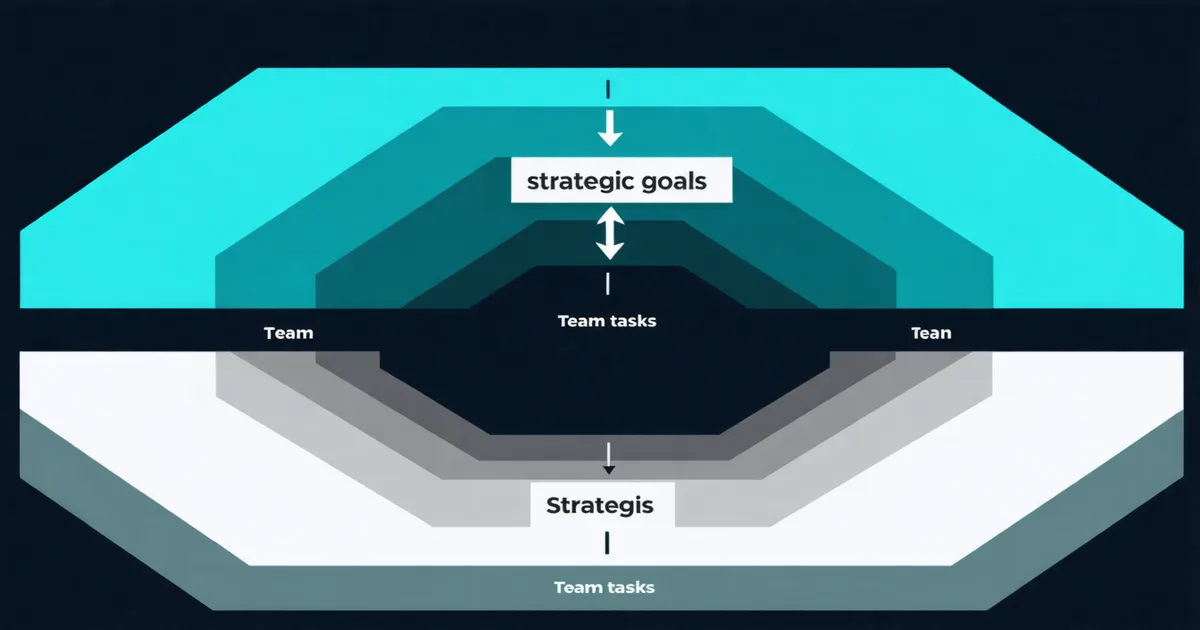
OKRs define what you're aiming at. Between the objective and the daily work, there is a layer that most organizations leave unbuilt — and that gap is where strategy dies.
Quarterly strategy reviews built on stale data don't surface the truth — they surface a retrospective narrative assembled three weeks after the facts shifted.
Practical thinking for COOs, VPs of Strategy, and leadership teams. No noise — only what changes how you execute.
No spam. Unsubscribe any time. Your data is processed in accordance with our Privacy Policy.