Most mid-market leadership teams have made the investment in OKRs. They have defined objectives that are directionally meaningful. They have attached key results with measurable thresholds. They have cascaded the framework from board-level intent down to department-level commitments. And then, somewhere between the key result and the actual daily work of the teams responsible for hitting it, the initiative loses traction — quietly, without a visible failure event, and without anyone being able to say with confidence exactly where the accountability chain broke.
The problem is not the OKR framework. OKRs are a good goal-setting tool. The problem is that goal-setting and execution management are different disciplines, and OKRs — by design — cover only the first. The gap between "key result: launch three new enterprise accounts in the DACH region by Q3" and the fifty decisions, resource allocations, cross-team handoffs, and dependency resolutions required to actually land those accounts is enormous. OKRs define the destination. They say nothing about the road.
What Ownership Actually Requires
When an organization assigns ownership of an OKR or a strategic initiative, it is typically assigning a sponsor — someone who is accountable for the outcome in a formal sense and who will report status at quarterly reviews. That is not the same as assigning execution ownership, which requires something more specific: a named person who is responsible for the intermediate decisions, who has documented the milestone cadence that the initiative will follow, who will surface blockers before they compound, and whose engagement with the initiative is observable to the team above them.
The distinction between sponsor accountability and execution ownership is subtle but consequential. A sponsor can be accountable for an outcome without being engaged with the execution mechanics. When the outcome falls short, the sponsor can accurately report what happened at the quarterly review — they have a narrative — but the execution failures that produced the shortfall accumulated in the weeks or months prior without visibility to anyone above the individual contributor level. The sponsor's accountability is retrospective. Execution ownership requires prospective engagement: being in the workstream continuously enough to see problems forming before they become failures.
Building this kind of execution ownership requires three things that most organizations have not systematically put in place: a documented milestone cadence for each initiative, an explicit expectation that the owner will maintain that cadence in a visible system, and a mechanism for leadership to see owner engagement without requiring the owner to file a weekly report. The last point is the hardest to operationalize without the right infrastructure, and it is the reason execution ownership so often collapses into sponsor accountability in practice.
The Orphaned Initiative Problem
The practical manifestation of missing workstream ownership infrastructure is what we call the orphaned initiative: a strategic commitment that has a named sponsor, has been included in the OKR tree, and has been allocated budget — but has no one actively navigating its execution on a week-to-week basis. The sponsor is accountable. The team is working. But the connective tissue that keeps the initiative on trajectory — the monitoring of milestone pace, the management of dependencies, the escalation of blockers — belongs to no one specifically. Or it belongs to everyone in theory, which means it belongs to no one in practice.
Orphaned initiatives do not fail loudly. They drift. The drift accumulates slowly enough that no single week looks alarming from any one team's perspective. The initiative is always "mostly on track" until suddenly it is materially behind and the first formal review in months is the mechanism that surfaces the gap. By that point, the options for course-correction have narrowed significantly.
A telling pattern: ask leadership teams to describe their most significant execution failures from the past two years. The stories nearly always involve an initiative where multiple people had partial accountability but no single person owned the end-to-end execution trajectory. The failure is attributed to cross-departmental complexity, resource constraints, or changing market conditions — all of which may have been contributing factors. But the enabling condition, in almost every case, was that no one was watching the trajectory continuously.
How Workstream Decomposition Closes the Gap
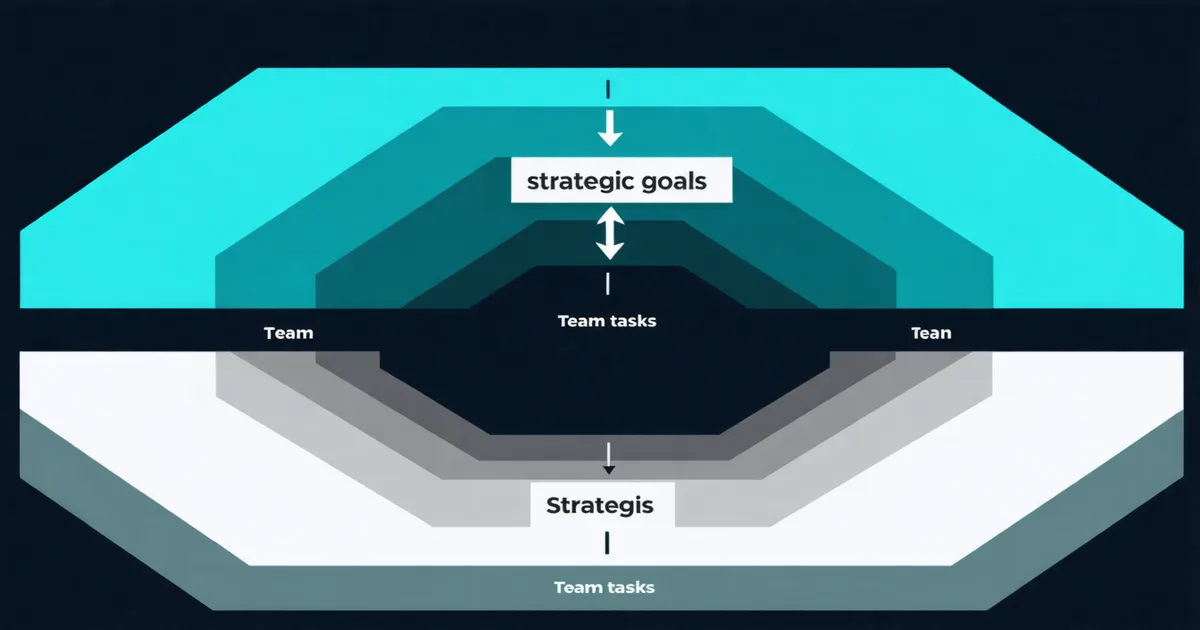
Workstream decomposition is the process of taking a strategic objective and breaking it into the discrete, owned execution tracks that together constitute delivery. The output is not a project plan — it is an accountability map. Each workstream has a named owner, a documented milestone cadence, and a defined set of dependencies on other workstreams or external inputs. The map makes visible the full set of execution commitments that the strategic objective implies, and it makes clear who is responsible for each.
Done well, workstream decomposition does something that OKR frameworks alone cannot do: it surfaces the hidden complexity of cross-functional strategic initiatives. An OKR that reads "expand into three new enterprise verticals by Q3" looks simple at the objective level. Decomposition reveals that it requires parallel progress on sales enablement, product adaptation, legal entity setup, and marketing localization — each of which is owned by a different function, each of which has dependencies on the others, and none of which can be meaningfully tracked from the OKR level alone.
Once the workstream map is in place, the ownership question becomes answerable in a way it was not before. Each workstream has a specific owner with a specific milestone cadence. That owner's engagement with the workstream is visible in the execution platform. Leadership can see — without scheduling a meeting — which workstreams are progressing as planned, which owners have gone quiet, and which dependency handoffs between functions are overdue. The accountability is no longer aspirational. It is observable.
Making Ownership Sustainable
One concern that leadership teams raise when they first encounter workstream ownership models is the overhead burden: if every strategic initiative requires a named owner maintaining a milestone cadence in a platform, have we just added a significant administrative layer to execution management? The concern is legitimate, and it points to a real failure mode in execution management infrastructure. Platforms that require owners to file detailed weekly updates, to score their progress against elaborate rubrics, or to maintain project plans that nobody above the team level will ever read create exactly the kind of administrative theater that causes ownership frameworks to be abandoned after one quarter.
The design principle that avoids this failure is exception-based visibility rather than comprehensive reporting. Workstream owners should not be asked to file status reports. They should be asked to maintain a milestone cadence in the platform — marking milestones as they are completed, flagging blockers when they arise, and noting when a dependency is at risk. The platform then derives the signal that leadership needs from that cadence data, surfacing exceptions (workstreams falling behind pace, owners going quiet, dependencies stalling) without requiring the owner to produce a narrative interpretation of their own progress.
This distinction — between active ownership and passive reporting — is what separates sustainable execution ownership infrastructure from the governance theater that most organizations have tried and abandoned. When ownership means maintaining a live cadence rather than producing a periodic deck, the burden is proportionate to the actual execution work. And the signal that leadership receives is more accurate, because it is derived from behavioral data rather than self-assessed narrative.